This discussion was co-ordinated in collaboration with S&P Global Sustainable1
As the impacts of climate change become increasingly severe, companies around the world are exposed to devastating financial damage. The world’s largest companies face cumulative losses of $25 trillion by 2050 under a medium climate change scenario, according to analysis by S&P Global Sustainable1.
While there is still work to do in strengthening data on companies’ exposure to climate impacts, leading figures in the sustainable investment community are recognising that imperfect data cannot be an excuse for inaction.
Asset managers are ramping up efforts to engage with companies, while catastrophe risk modelling conducted by insurers is being harnessed by managers to understand the costs and benefits of adaptation measures.
Although adaptation measures are generally framed as being necessary to avert further losses, some financial institutions are also beginning to recognise that investments in adaptation can also provide opportunities. These opportunities are sure to come into sharper focus in the coming years as the need for societal resilience becomes impossible to ignore.
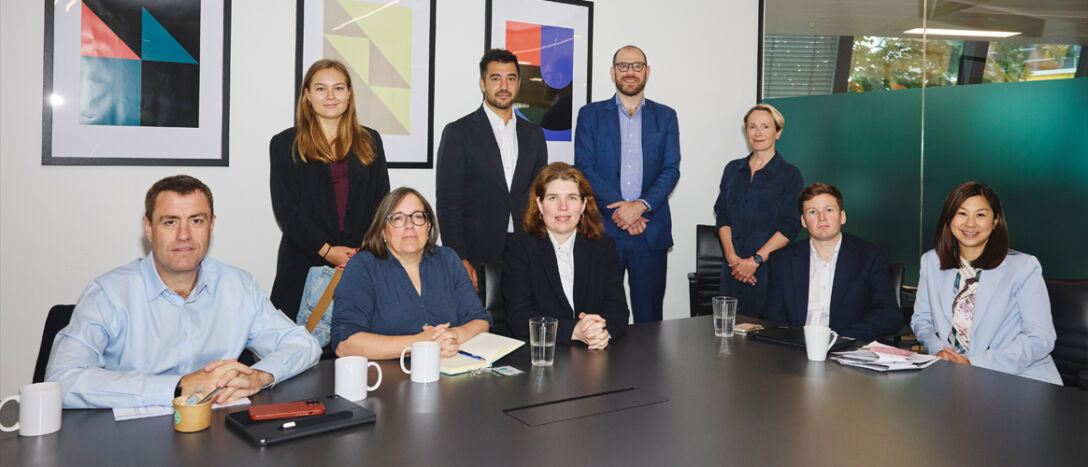
Together with S&P Global Sustainable1, Responsible Investor convened a roundtable to bring together some of the top minds in sustainable investing to explore risks and opportunities around adaptation in a discussion moderated by RI editor Lucy Fitzgeorge-Parker.
The panel
Associate director, climate,
Fidelity International
Sophie Brodie
Head of sustainable finance solutions, adaptation and resilience,
Standard Chartered
Alex Kennedy
Senior climate change analyst,
Aberdeen Investments
Anna Moss
Managing director, global head of research and methodology,
S&P Global Sustainable1
Steven Bullock
Global head of sustainable investment,
Schroders
Andrew Howard
Head of responsible investment strategy,
Legal & General Investment Management
Amelia Tan
Assistant manager, engagement, Europe,
Federated Hermes
Hannah Heuser
Vice-president, global climate research and strategy,
PGIM
David McNeil
Physical risk exposure & financial impact
Just how significant is the financial impact of physical climate risk likely to be?
Steven Bullock: We have a team of climate scientists and strategists that sit in what we call our Climate Center of Excellence. That team is focused on answering precisely this question, and on exploring the intersection between climate change and financial impact.
At the start of this year, we released some research based on a review of the S&P Global 1200, comprising around 3.5 million assets owned by these companies. That research explored the financial implications of those assets’ exposure to climate hazards including wildfires and coastal flooding. What we identified was a cumulative impact of around $25 trillion by 2050.
Significantly, that $25 trillion is baked in, irrespective of the climate scenario and without adaptation. We were also able to provide visibility on how specific sectors are likely to be impacted. Perhaps unsurprisingly, the more capital-intensive sectors, such as utilities and energy, were most exposed. Finally, it is worth highlighting that even though acute climate hazards are costly, the most significant impacts we identified related to chronic hazards such as water stress and extreme heat.
How are investors grappling with the need to understand these physical climate risks?
Andrew Howard: From a top-down perspective, we have long run economic forecasts, and those forecasts have been adapted to reflect the impacts of climate change on the economic growth rates of different countries and on return expectations for different asset classes.
The other piece we have done is more bottom up. That is more challenging. Seven or eight years ago, we created a model that essentially asked the question, how much would it cost a company to insure against the physical damage or expected physical losses associated with climate change over the remaining life of those assets?
“Adaptation has always been the poor cousin to mitigation”
Anna Moss, Aberdeen Investments
Data availability has improved over that period but still remains a big challenge when it comes to quantifying those costs. I also agree with Steven, in that there is a tendency to focus on acute hazard risk, rather than chronic systemic risks associated with heat and water stress. Those things may feel as though they are further away but in fact that is where the biggest impacts are ultimately going to be felt.
Amelia Tan: We have a climate change modelling toolkit called Destination@Risk. Based on its scenario analysis of different climate pathways, it allows us to determine the value at risk and the gap to get to net-zero emissions from a climate transition perspective. This approach incorporates chronic physical climate risks associated with temperature rises. For example, it considers the impact of higher temperatures on labour productivity and therefore on GDP.
David McNeil: Like others here, we can approach this from both a top-down and bottom-up perspective. Considering interactions between macro-level shocks such as food inflation and the potential for repricing of risks at the sectoral and then company level is one approach. For some asset classes such as real estate, we can also look at this from the bottom up, building physical risk exposure and vulnerability into underwriting and cashflow assumptions at an asset level and then rolling that up to gain portfolio-level insights as well.
Anna Moss: We have been doing climate scenario analysis work for the last five years, which has largely emphasised the transition risk. We are now increasingly focusing our attention on physical risk and adaptation, bearing in mind the challenges that come with that. We can gain some kind of top-down understanding, in terms of identifying subsectors and regions at risk, which helps us to broadly assess risk across our portfolios. We can then combine that with bottom-up insight, whether through direct engagement or in-depth research. With our real assets, however, the focus is on a bottom-up approach from the start.
I come from a policy background, where adaptation has always been the poor cousin to mitigation, and I think the same is still true for much of the finance sector, where transition tends to dominate discourse. But I am starting to see more interest from clients in the adaptation story and that is helping us to get internal buy-in across the different asset classes.

Sophie Brodie: Our macro team has integrated climate factors into their long-term capital markets assumptions as a means of supporting asset allocation. In the absence of aggregated physical risk asset data at portfolio level, which is only now starting to come through, we have also been looking at this issue through a stewardship lens. We did some analysis of sector exposures as part of our Nature Roadmap, which we published in 2023, and the key finding that emerged from that was water risk. We therefore embarked on a water risk thematic engagement.
Hannah Heuser: One of the challenges when it comes to quantifying physical climate risk is the need to incorporate wider indirect risks. A company might be taking windows out of its buildings to reduce heat stress, for example, but if you have several months in the summer where workers are affected by heat, you also need to consider whether there is AC on the metro as they travel to and from work, and whether the health system in the local area is equipped to deal with significant increases in people collapsing from heat. All these factors can have knock-on effects for the business and for the wider economy and that’s hard to quantify because there are so many interacting factors at play.
Are banks taking a different approach to this problem?
Alex Kennedy: Three years ago, we commissioned a report to understand whether or not, in terms of avoided losses for our clients, we should care about adaptation and resilience. Across our footprint in Asia, Africa and the Middle East, 90 percent of our markets are coastal. So, to a certain extent we knew what the answer would be.
“The most significant impacts we’ve identified relate to chronic hazards such as water stress and extreme heat”
Steven Bullock, S&P Global Sustainable1
We took our top 10 most vulnerable countries – Bangladesh, Pakistan, India, Vietnam, the Philippines, Indonesia and others – and we mapped out how much $1 spent now would save by 2050 in terms of avoided losses. The bottom line is that in those 10 markets – the most acutely vulnerable when it comes to the impact of climate change and extreme weather – $1 invested equates to $12 saved by 2030, underscoring the critical importance of adaptation and resilience.
What are the challenges involved in translating that recognition to concrete action?
Alex Kennedy: There are a number of myths in the adaptation and resilience space that I believe are stopping finance flows from the private sector. The first is this issue of not being able to look “beyond the seawall”, as it were. It can be difficult to get people to really understand that adaptation and resilience is about more than just coastal infrastructure. It is also about health, education and agriculture, for example.
The second challenge is the idea that adaptation and resilience are government problems, not bank problems. Some also might believe that it’s not possible to make money out of adaptation and resilience – and this is the greatest myth of all.
You can take people back to the “$1 now saves $12 later” finding, but that is still just about avoided losses. We try and frame this as an opportunity. We have produced a framework for adaptation and resilience that contains over a hundred investable opportunities, including everything from agriculture to infrastructure, to help people see beyond the seawall.
Data gaps and how to overcome them
Banks are sitting on a lot of data. So are insurers, and there is all this new, geolocation data available too. But are there still data gaps?
Amelia Tan: There have been clear improvements in terms of data providers’ ability to connect geolocations to companies. That’s a great starting point. The challenge we are now facing, however, is discerning how material a particular asset is to a company. That’s an important data gap.
The second data gap involves the supply chain. As Hannah says, physical climate risk is not only about what happens within the company. Significant disruption within the supply chain will impact a company and so it is important to get a sense of where companies are sourcing their materials from.
Anna Moss: Physical risk is obviously highly location-specific, so we need to have databases that can give us a proper sense of what companies are doing and, importantly, where they are doing it. We’re starting to see a build-up of those databases, which is great. However, the sheer volume of data available can sometimes belie problems with data accuracy and data quality. You have to make sure that the data itself is actually useful.
Andrew Howard: There has been this sense for a long time that all we need is more data – that data is always the solution. It is really important, however, to start with the question that you are trying to answer and to work back from there.
“The most significant impacts we’ve identified relate to chronic hazards such as water stress and extreme heat”
Steven Bullock, S&P Global Sustainable1
To my mind, those questions are threefold. First, how are the company’s physical assets going to be impacted by the direct effects of climate change? Then, how will the systemic effects of climate change impact the value chain of that company? We all tend to shy away from that question because the data is not as good as location data, but it is hugely important and there are ways to tackle it. For example, we have done a lot of work using input-output tables, although that is more sectoral than company-specific.
The final question, meanwhile, involves the extent to which a company’s actions are mitigating the impact of those exposures. At the moment, two companies with similar business models and location footprints are going to come out looking similar in the data. However, the steps they are taking in terms of asset development, as well as their broader strategy around business model and supply chain resilience, are going to make a significant difference to how exposed to physical climate risk they are.
Each of those three questions needs to be tackled separately as they require slightly different tools. But I think it’s important to start from the question, and then use data to answer that question, rather than starting from the data itself.
Hannah Heuser: I completely agree with the materiality point, and I think it is important to make the distinction between acute physical risk impact and chronic risk in this context. With chronic risk, everyone in a certain geography is going to be hit in the same way. While effectively managing chronic risks could pose a competitive opportunity for some companies, chronic risk largely creates a level playing field, which means it is harder to identify the materiality of those impacts.
But, with acute risks, we want to be able to quantify the avoided losses. We don’t want companies to only react to physical risk once they have already been impacted – to build resilience post-event. I therefore think there is a role for data to play in monitoring action taken before something happens. There is currently no real visibility on that.
Steven, as a data provider, what is your approach to bridging these gaps?
Steven Bullock: Our philosophy has always been that you need to build more granularity and specificity into the way you think about the world and the hazard exposures that exist in different locations, leveraging the very best climate science available. But really, that is table stakes today. The question now is how you connect that information to investment and business decision-making.
To that end, we have been focusing on two main areas. The first is obviously geolocation. We’ve been collecting asset-level data for many years including, as I mentioned earlier, around 3.5 million assets owned by the world’s largest companies. We know the geolocation of those assets and we can provide granularity on hazard exposure.
The second area of focus involves the financial implications of that hazard exposure. That can involve looking at typical repair costs, for example, or the operational costs of maintaining cooling systems during heat waves. We can also look at productivity loss at an asset level. It’s all about connecting that climate science to something that can be integrated into decision-making.
“The bigger issue is how we connect data to metrics”
Alex Kennedy, Standard Chartered
To date, the focus has primarily been on mitigating risk and we could easily spend the next four or five years investing more in increasing the resolution of the way we assess financial impact exposure.
But really, if we accept there is a material financial risk out to 2050, irrespective of the climate scenario, we may be better off spending our time thinking about enhancing transparency on the adaptation opportunities that relate to the hazards that we’ve been analysing. That is quite a challenging prospect, because there is not much data out there, but through direct engagements with companies and with investors, we can start to bridge that gap.
Alex Kennedy: There is no doubt that the quantity and quality of data is growing – you only need to look at the number of private equity firms that are investing in dedicated climate data companies. I think we will get to where we need to be within the next few years, when it comes to data.
The bigger issue, however, is how we connect that data to metrics. The heterogeneity of adaptation and resilience solutions, in terms of both asset type and geography, means identifying the right metrics can be more challenging than it is for mitigation, which centres around CO2 avoidance. Water, health and infrastructure, for example, all have very different metrics and we need to find some commonality.
As a bank, we tend to focus on dollar value. Others focus on the number of people affected. What is clear though is that establishing some kind of standardised metrics around adaptation and resilience will be key.
The importance of engagement
Where does data aggregation stop and direct engagement begin?
Sophie Brodie: It’s great that we have all this new data coming through, particularly in terms of asset-level hazard data, but we also need a bottom-up qualitative view from the company itself, particularly when it comes to the materiality point. The percentage of assets at physical risk is just a conversation starter. We need that qualitative information around those metrics to make sense of them, and from there we can discuss what adaptation measures the company is taking.
“The percentage of assets at physical risk is just a conversation starter. We need qualitative information around those metrics”
Sophie Brodie, Fidelity International
Hannah Heuser: We definitely believe in engagement and in actually speaking to companies to get answers to some of these questions that all of us around this table have been posing. That is the most direct way to get data, after all. But there are also thousands of companies that we don’t speak to on a regular basis, so we have to plug those informational gaps.
David McNeil: I would agree that qualitative information is required alongside quantitative information, particularly when it comes to assessing acute risk exposure alongside vulnerability. Take all those APAC auto and electronics manufacturers that had their supply chains disrupted during the Thai floods of 2011 and that have subsequently invested heavily in supply chain diversification, risk mapping and continuity planning.
Standardisation of disclosures will obviously help in gathering information around readiness for that acute event risk, but a lot will still come down to qualitative engagement and making sure you are asking the right questions regarding an entity’s ability to adapt to operational or supply chain disruption.
Anna Moss: Identifying maladaptation is a key part of engagement. Maladaptation relates to unintended, negative consequences from the adaptation process. To put it crudely, if you build a seawall in one location, are you creating a worse situation further down the coast? If you build a reservoir to solve a water access issue, are you preventing irrigation further downstream? A Climate Policy Initiative assessment determined that just over a quarter of adaptation investments analysed contained some form of maladaptation. Building those kinds of questions into engagement with companies is therefore critical.
How to frame a compelling investment case
Having gathered all this information, how can it be framed as a compelling investment story?
Andrew Howard: It is easier to translate the transition piece into an investment story because you can readily identify a whole series of catalysts, from regulation through to various growth drivers in different industries. It is more challenging, currently, to do that with direct physical impacts. We can cite examples such as the PG&E bankruptcy, but those are clearly high-impact, low-probability risks, which can be tricky for individual companies to assess and act on. They are also tricky to translate into dedicated portfolios focused on risk mitigation.
To make things even more complicated, when you are looking at 2100 scenarios in a – let’s say – 10 percent discount world, that equates to almost nothing in today’s money. The models that are being used for decision-making just don’t lend themselves to risks that are rising exponentially over time.
If the rate of exponential increase is lower than the discount rate you are applying, the economically rational thing to do would be to wait until the world is on the brink of collapse rather than spending a relatively modest amount of money in the short term. What that clearly tells us is that finance alone is not going to come up with the answer. We are going to need policy intervention as well.
Amelia Tan: I agree. The challenge with those far-off scenarios is that companies are not going to spend a lot of money now to try and fix something that may or may not happen in 100 years’ time. What does matter though is what happens today, which brings us to the topic of insurance. One of the companies we have been engaging with is a REIT that has property portfolios in Hong Kong, where flood risk was assessed as a real issue.
The property investment company, on its own initiative, introduced flood gates and new drainage systems, and then went on a roadshow to insurance companies to advertise how it had reduced potential losses by between 10 and 20 percent. As a result, premiums decreased by 11 percent that year. That is an immediate cost reduction, and I think that is how you translate that far-out scenario into real, near-term money implications to drive companies to act.
Alex Kennedy: Banks haven’t fully priced physical climate risk into credit decisions, and the concept of better insurance conditions is a great case study. Banks need to figure out how to do the same thing. We could, for example, integrate adaptation and resilience into our client credit risk scoring. We could also work it into our risk weighting calculations. Equally, however, I think we should try to push for external supporting factors. What role can central banks or regulators play? If these investments are going to prove critical to the de-risking of the whole financial system, policy incentives for lenders would make a lot of sense. We need to reward clients that are doing the resilient thing.
Sophie Brodie: I think one-in-X year event modelling can be helpful. If, for example, you assume you have a 20 percent chance of experiencing an event in any given year over five years, then take a cumulative risk approach for each year that an event doesn’t happen. Even if there isn’t an immediate insurance risk, that kind of modelling can help reframe the investment case within a meaningful timeframe.
David McNeil: There is definitely good potential for insurance catastrophe risk models to be used by investors and asset managers, particularly when it comes to valuation of real assets. The market increasingly points to risk premiums for energy-inefficient, carbon-intensive real estate assets, for example. But the physical risk side of the equation is often more asset and context-specific.
“The physical risk side of the equation is often more asset and context-specific”
David McNeil, PGIM
Having access to data from the catastrophe risk model providers and then building in your own cost and cashflow assumptions and knowledge of the asset can enable you to capture the costs and benefits of any adaptation or resilience risk mitigation efforts – whether in terms of ‘hard capex’ or ‘soft opex’ measures.
Andrew Howard: We have an insurance-linked securities team that does a lot of work around catastrophe bonds, but the depth of the modelling they use is completely different to anything we have in the public equity space. The insurance industry is really on top of this and so I think there is a lot of value to be had in connecting disciplines.
Hannah Heuser: I agree. I think information pertaining to physical risk and resilience does exist within a lot of companies, but it tends to be siloed within the teams responsible for insurance, and therefore isn’t made available to investors and isn’t integrated into company-wide strategy to support decision-making and investment planning either.
I would add that we are starting to see this concept of self-insurance gathering momentum. Companies are finding that premiums are just too high or that insurers are unwilling to provide insurance and so they are putting money aside in the event that something happens. The question then is how much are you putting aside? How are you reaching that assessment? That creates a whole new space for inquiry and for ensuring companies are building resilience.
If companies view adaptation and resilience as an insurance issue, how willing are they to engage with you as investors and lenders on this topic?
Andrew Howard: Generally speaking, we find companies are happy to engage on this topic. We don’t often hear people palming this off as someone else’s problem, not least because the future has already happened – the impacts that take place over the next couple of decades are based on emissions that have already occurred. There is an inevitability here that is reasonably well accepted by most of the companies that we talk to.
Equally, there doesn’t seem to be much debate about whether this is something that companies should be trying to deal with. There may be disagreement when it comes to how, or how much, but for the most part we experience constructive engagement.
Alex Kennedy: The thermostat has been turned up, but the oven hasn’t yet caught up and we still haven’t seen the worst impact of climate change, despite the impacts of extreme weather already playing out globally.
You only have to read what Sandy Trust from the Royal College of Actuaries has written about tail risks, and there being an 18 percent chance we might reach 4.5C of warming or more at current levels of GHGs. In those scenarios, you are potentially looking at 50 percent GDP contractions between 2070 and 2090. His message, therefore, is that this needs to be baked into financial decision-making as soon as possible.
Advocacy & opportunities
What role do you see asset managers playing in policy advocacy in the context of climate adaptation and resilience?
Anna Moss: We are currently seeing some reticence among asset managers with regards to sticking their head above the parapet on policy advocacy when it comes to climate mitigation. But I am hoping there will be less nervousness around advocating for the necessary adaptation policy.
Is that because adaptation is a local issue whereas mitigation is global?
Amelia Tan: I think there are three things that support policymaker receptiveness to policy advocacy in this space. The first is, as you say, that it is local. The second is the time horizon. There is a clear and present danger. This is something that is already happening in terms of wildfires, hurricanes and flooding. The third, meanwhile, is the narrative. This is about resilience. You can take out politicised notions of sustainability and ESG, and simply talk about doing what is right for the people directly involved.
Where do you see the most interesting climate adaptation and resilience investment opportunities today? Have we reached a level of maturity where a best-in-class strategy could identify adaptation winners?
Anna Moss: There is definitely client interest in that kind of approach. We are getting increasing interest in products that are focused on identifying adaptation leaders and solutions across a broad spectrum of sectors. To be pragmatic, we are starting with companies with which we are already familiar and where we can have confidence in the risks involved. As our assessment methodology matures, it will become easier to identify the expanding investment universe required to provide adaptation solutions and build resilience across all sectors and regions.
“It is important when talking about any aspect of sustainability to bring it back to investment fundamentals, and from our perspective we want to buy cheap”
Amelia Tan, Legal & General Investment Management
Sophie Brodie: Adaptation as a thematic opportunity set, globally, is still only a small part of the overall universe. It hasn’t yet broadened out to encompass deployment of solutions across every sector.
But I think we will get to a point where we are looking at an opportunity set, as well as a risk set, because companies will recognise that they can reduce their cost of capital by making these investments, thereby making themselves an adaptation leader.
Andrew Howard: The challenge is that with best-in-class, the aim is to pick the top 5 percent of companies per sector, but the likelihood is that in most years over the next few years that won’t materialise into an observable benefit. These kinds of high-impact but low-probability discrete exposures don’t lend themselves to smaller or more concentrated portfolios. If you get it right, you are a hero, but there is a good chance that you won’t be.
Steven Bullock: The idea of picking adaptation leaders is really interesting from a data perspective. We engage with thousands of companies every year, and we do celebrate leaders in different areas, such as disclosure, but there is certainly an opportunity to broaden that out to identifying leaders within specific segments or locations.
Sophie Brodie: It all comes back to the issue of time horizon and investor profile. Some clients are going to be happy to take a longer-term view, while others will prefer to focus on near-term factors. I think it will really depend on client preference.
Amelia Tan: Then there is the question of, at what price? Are you buying a leader that has priced in its leadership? What is the relative price that you are buying at? That is, in many ways, the most important question. For example, we have a climate action strategy that actually looks to invest in climate laggards.
The rationale is that we believe we can engage with these companies in a meaningful and targeted way, thereby accelerating their transition and unlocking shareholder value. It is important when talking about any aspect of sustainability to bring it back to investment fundamentals, and from our perspective we want to buy cheap.