
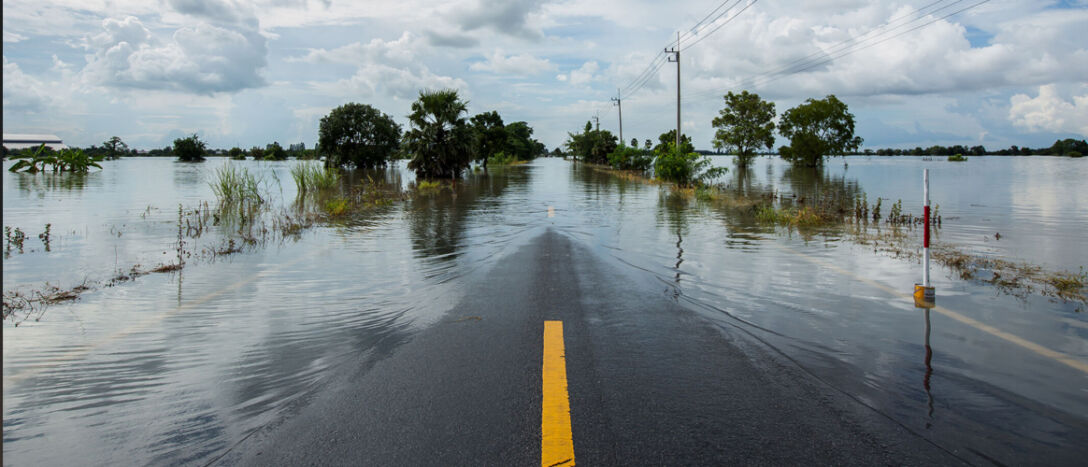
Physical climate risk is becoming harder to ignore with real estate assets particularly exposed to increasingly severe storms, floods and other disasters. According to the European Environment Agency, climate extremes caused €822 billion in losses between 1980 and 2024; a quarter of these losses occurred in the 2021-24 period alone.
Alongside physical damage to assets, it also falls on banks and asset managers to grapple with the risk of indirect losses, which can occur when climate shocks lead to business disruption through their effect on nearby infrastructure or on supply chain partners.
Tools to assess physical climate risks have become more sophisticated in recent years, although many finance professionals remain wary of the tendency for different providers’ tools to deliver different results. Further, ensuring that risk assessments and scenario analyses are properly factored into decision-making remains a work in progress.
To explore the challenges around physical climate risk in more detail, Responsible Investor and Climate X, a climate risk data and analytics company, hosted a roundtable discussion with leading figures in sustainable finance, moderated by RI editor Lucy Fitzgeorge-Parker.
The panel
Head of responsibility and ESG,
Orchard Street
Kathryn Barber
Sustainability compliance manager,
LCP UK
Caroline Holman
Director, global head of sustainability,
DWS
Aleksandra Njagulj
Head of sustainability,
Athora
Matt Bullivant
SVP and portfolio manager,
PIMCO
Nick Minto
Head of sustainability,
Patrizia
Edward Pugh
Enterprise account executive,
Climate X
Cain Christoforou
Head of ESG, real estate,
Aberdeen
Georgie Nelson
Strategic account executive,
Climate X
Utsha Saha
How is physical climate risk evolving as a material risk? And is it translating into a financial signal?
Georgie Nelson: Physical risk is now regarded by much of the investor community as the most material risk, even above decarbonisation. The challenge we face is that we’ve integrated the assessment of physical climate risk throughout our investment process, but we don’t necessarily believe what the third-party models are telling us.
The results are wildly different depending on which private provider you use, and it’s hard to get the granular detail you need for a real estate portfolio. We use one provider, but our insurers use different providers and flag different assessments. In the UK, it’s a little bit easier, at least for flooding, because everyone can rely on the local government flood maps. But globally, assessments can be more varied. The biggest fear is evaluating something as a low risk, but it turns out to be a high risk.
Nick Minto: Physical risk is probably the tangible ESG factor for us to benchmark when we think about asset performance and asset resilience. We have to think about both how physical risk and the costs of that are reflected in opex, and also how that’s reflected in exit multiples.
For real estate in Europe, the most straightforward piece is flood risk, but there are a whole range of risks we have to think about globally. How do you price it? How do you think about creating resilience in the income return? And who pays for it?
“You might want a universal data set, but the application of that data is not uniform”
Matt Bullivant,
Athora
Matt Bullivant: Coming at this from a portfolio-wide scenario analysis consideration, the question is whether you want the top-down scenario model that gives you the systemic view, or do you want the granular bottom-up visibility? And the answer to that question is invariably that you will need both. But when do you need what? And how do you go about getting it?
Do you really want a different data provider for each different asset class? Are you looking at individual assets, like you might be for real estate? But what about extended supply chains, where you’ve got physical impacts, but that is much more on the value chain, rather than on the asset valuation side of things?
There’s a lot of different component parts here. In some respects, you might want a universal data set, but the application of that data is not uniform. Also, there’s a consideration in terms of which exposures are likely to be more material financially, and how far you need to go to look for data to help you address those risks. It’s all a bit of a minefield.
How much progress have you seen in developing an ecosystem around assessing physical risk?
Utsha Saha: We’re seeing a maturity evolution. People started off realising they needed to do something about physical risk. Then there was a period where people had the data, but questioned whether it was decision-useful, whether it could be trusted, whether there were standards governing the data quality. At the same time, there’s been an evolution in regulation and an evolution in technology.
There are so many inputs into climate science models today, and we’re trying to think about how we can have transparency and good validation metrics. Now that people are starting to be aware of regulatory drivers, and investment committees are questioning data, and we’re seeing more physical climate risk events, the onus is on us to validate the data that we provide. We’re not just working with investors; we’re working with entities regulated by the Prudential Regulation Authority. They have a lot more requirements for transparency and granularity, and they will interrogate which models are being used, which proxies are used to fill gaps, and how the data is validated.
“There are so many inputs into climate science models today”
Utsha Saha,
Climate X
At the top level, the technology has massively evolved, even in the last five years. We now have 11 physical risks that we can model. We’re at a point now where people are starting to increase in maturity and realise this differentiation is needed.
It’s good that we’re at this intermediate point, because now we’re able to really work in partnership and help investors understand where risks are material to their businesses, and how they affect opex and valuations, so they can understand where they need a bottom-up view.
Edward Pugh: The problem is we have these 20-year forecasts for climate risk, but we don’t have 20-year forecasts for insurability on any of these other factors. That makes it really difficult to match underwriting to the climate risk. People stop at the bottleneck and say, ‘well, we’re able to insure the asset today, so it’s fine’. So, we’re not able to marry insurability and climate risk very well.
Are physical risk assessment tools fit for purpose?
Caroline Holman: We’ve had some challenging but productive conversations with the banks. We have just walked away from a real estate transition-linked loan, having already tested a sustainability-linked loan on a small portfolio of circa 50 properties with the same bank. The main obstacle was the bank’s insistence on the use of a particular green building assessment tool; we had already proved it was not fit for purpose. To meet the loan criteria and achieve the basis points reduction, the KPIs were linked to a model that did not work.
However, the outcome was that they listened and took this feedback away and are now reviewing that tool. We have also proved that we are not averse to pursuing new opportunities; but the lesson is, don’t be afraid to say, ‘actually, this doesn’t work for my portfolio or business’.
Kathryn Barber: Some of the providers are very black box in terms of their inputs. That’s challenging when it’s being positioned as your net risk, when actually it should be your gross risk.
Definitely in the UK, it is all about flood risk. Physical climate risk does equal flood risk, because that is the binary metric; that is what stops acquisitions or sales. Everything else is fixable with capex.
We’re doing a lot more on the transition risk side, although it’s not labelled as that. Decarbonisation is the focus from a regulation and compliance perspective, but that then is driving consideration of heat stress, for example, in terms of how we’re repositioning buildings, because we’re seeing that come through on the tenant side. Tenants want to know if their space will be sufficiently cool with warmer summers.
To what extent are use cases for adaptation finance gaining traction?
Cain Christoforou: We work with banks as well as asset managers, and we are seeing a massive increase in use cases for adaptation finance. Sustainability-linked loans are used as a value driver and because banks have regulatory requirements to give out green loans. That’s massively picked up over the last two to three years.
Insurers look at much shorter time horizons. Typically, they insure over one to three years, whereas climate scenarios play out over longer time horizons. But we have started to see that the more people have access to information on the granular asset-level detail around physical risk, the more it’s being priced-in, from pre-acquisition, during acquisition, during the hold period of the asset, to the sale of the asset. More people have access to information than they did three to five years ago, so more questions are being asked.
Matt Bullivant: Part of the challenge around adaptation finance from a physical climate resilience point of view is that in many instances you’re effectively paying money to continue doing what you’re doing anyway.
Arguably on the transition side, decarbonisation has commercial value uplift from additional rental yields or energy savings. Whereas with physical risk, it’s not even a choice. You just have to be able to defend yourself against floods or wildfire or whatever else it might be, in order for the asset to continue doing whatever it does anyway. That’s quite a tricky thing to put into a valuation model.
“The same high-risk asset can be viewed differently depending on portfolio size and risk spread”
Kathryn Barber,
Orchard Street
Kathryn Barber: The questions we get from banks are very mixed. My impression of that is while they might be asking about physical climate risk, even for sustainability-linked loans, it’s not actively a decision factor. The questions are, ‘Do you have a decarbonisation plan? How are you improving the EPC?’ It’s those regulatory metrics, not the physical climate piece. Even if they’re asking questions, I don’t believe that they’re doing anything with the outputs of that yet.
On the insurance side, obviously that’s much more evident. But quite an interesting point is it also depends on how you’re insuring the assets. Is it part of a portfolio of £50 million? Is it a £1 billion portfolio? The same high-risk asset can be viewed differently depending on portfolio size and risk spread.
How do you evaluate what a resilient asset actually looks like?
Nick Minto: A resilient asset can perform beyond just one single state. It means an asset works in the base case, and it can perform within a range of scenarios. If an asset has a one-in-33-year flood risk, you can’t know if that flood risk is going to materialise in your five-year hold period. But you need to know: can the asset and its income be resilient, not just in the base-case assumption, but also in those upside and downside scenarios? It comes back to how much is enough.
Aleksandra Njagulj: You can have 100 possible measures to deal with a certain risk. Some of them are going to be more efficient than others, some would be more expensive, some would be more difficult to implement, and so on. So how do you evaluate them? And then, how do you say what is enough?
Wellbeing is one metric. You think about overheating – thermal comfort is going to be a resilience metric for real estate. So, do you have the systems that can withstand hot periods and provide cooling? And do you know how much energy that will use, what it will cost, and how that impacts transition risk?
“You can have 100 possible measures to deal with a certain risk”
Aleksandra Njagulj,
DWS
As an asset manager, you have a list of possible measures for every possible risk, then you scale them by how expensive and difficult they are, and by how efficient they are in improving resilience. You want to push those measures that are easier to implement, and as cheap and as effectively as possible. You’re not going to be putting green roofs on buildings to reduce the flood risk, because that’s terribly expensive, and really difficult. There are other, cheaper measures.
Georgie Nelson: It’s important to think about three levels of resilience risk. There’s the exact location of the asset that’s impacted. There’s the infrastructure around the assets; even if your asset is safe from flooding, the tenant might not be able to access it. Then there’s the third level, which is the business disruption. The building might be fine, but the tenant might be hit by a climate risk in another location, and that completely disrupts their business. That part is the hardest bit to deal with as it’s out of your control, but is important to protect the income.
Utsha Saha: Banks are starting to think about how to assess corporate risk. Business disruption can be another key criterion for resilience at the corporate level, because it’s often actually less the asset damage that is material and more the business disruption. Obviously, that depends on the asset types; if you’re looking more at commercial or industrial real estate, that’s where this becomes relevant.
The first step to figuring out and defining a resilient asset is to segment the asset types and use cases. For the banks we work with, they’re typically only looking at the actual asset damage. But once you start looking at different kinds of asset types and what they are being used for, that’s where we can start to align on the need to look at business disruption.
A lot of the physical risk assessment done so far has been driven by regulations. Do you see regulators playing a greater role in adaptation?
Edward Pugh: It could come through on the adaptation side to building regulations and planning. If you look at Japan, for example, it has physical risk with earthquakes and tsunamis, and many assets can’t get full insurance coverage. But Japan has several layers of defence.
Part of it is public-private sector partnerships to absorb the risk, and the way that the government is able to do that is by having really strong building regulations around earthquake resilience and so on. So, if you look at that as an example of a very mature market, you could see stronger measures start to come through more in building regulations.
How much alignment is there within firms about assessing physical risks? Are sustainability, compliance and investment teams on the same page?
Utsha Saha: Improving assessment of physical climate risk is a matter of education. Some of the folks we speak with are already investing in climate risk. But one of the barriers for them to price it in and have it more embedded in a standardised way is they don’t trust the data, or they don’t understand how it works.
“The whole industry has a backwards-looking mentality in how valuations are done today”
Edward Pugh,
Patrizia
It is interesting to see the amount of people that bucket physical climate risk within the broader climate change and sustainability world. There’s a dimension of change management here as well, which is really critical if we want investment teams to embed this in a standardised way.
Edward Pugh: The whole industry has a backwards-looking mentality in how valuations are done today, whereas we’re trying to say the data saying risks could happen in the future needs to be taken much more seriously. When you talk to people about how they change their investment decisions based on the data, they have one view. And if you say, ‘Well, if there had actually been a flood three years ago, would that change how you approach this?’ And they all basically say yes. But it shouldn’t.
Matt Bullivant: It’s easy to fall into the trap of simply going through the motions, performing a climate scenario analysis and stress test, but then just carrying on with business as usual having ticked the box of doing a scenario analysis. You can have the most advanced methodology in the world, but it won’t make a difference if you’re not tying it properly to your risk appetite and your risk metrics and making it relevant for decision-making.
What do you see as the next steps to improve how physical climate risks are assessed and factored into investment decisions?
Georgie Nelson: For me, the data piece is most important. Getting the local data sets integrated into high level models is key, and that will help the decision-making. And then the next point is building on how we’ve been able to estimate decarbonisation costs, and finding a similar way to do that for adaptation. When we can rely on that data more, we have a very easy way to then map out adaptation cost in our cashflows.
Kathryn Barber: In terms of immediate priorities, it’s definitely the insurance angle for us, digging into the types of models that they’re using, and questions around that. We want to build on some of the initial work that we did two or three years ago, to really integrate it into more of what we’re doing.
“Getting the local data sets integrated into high level models is key”
Georgie Nelson,
Aberdeen
Caroline Holman: Building advocacy and working with key stakeholders to clearly define and quantify risk, and what ‘resilience’ means to the business, now and in the future. This will also aid discussions with the banks as we achieve greater alignment and synergy.
We haven’t been good on collecting historical evidence and data, but the goal is to build on the progress we have made and evidence what good and bad looks like to better inform acquisition and investment decisions.
Utsha Saha: What I would love to see is that we as an industry start to talk about the cost of inaction. That’s what will start to get the attention of the adjacent stakeholders and the investment decision-makers. How I try to approach that is trying to build trust and collaboration and transparency.
Edward Pugh: Depending on what’s happening in geopolitics, there either will be more mitigation or there’ll be more adaptation. And now, we’re swinging towards physical risk adaptation, because there’s less globalisation and an effort towards the mitigation side.
But in Europe, it’s like we’re struggling on both sides, because we should do adaptation. We’re also going to face the consequences of other parts of the world not mitigating, whereas the US has gone all in on adaptation rather than mitigation.
Cain Christoforou: There’s going to be a path towards more of us, from a provider perspective, having more alignment. We’re not predicting – we build probabilistic models, and how you build those models are at the centre of what the outputs are going to look like. We were built primarily from a scientific background and designed for the financial services industry, which is why a lot of what we’ve built is trying to marry the science and quantification and how that actually impacts. But it’s not a perfect science. So, we’re super focused on trying to be as granular as possible.
We’re trying to lean into the value creation piece. So, how do you actually start to adapt your assets? What is the capex, and what is the impact of the physical risk on those? We need to go beyond the physical risk within asset managers and banks, and give greater consideration to the wider ecosystem.